How to Choose a Card Reader ATM Machine for Your Business
- Jul 6
- 10 min read
Updated: Jul 9

A card reader ATM machine is more than a cash dispenser with a slot for plastic. For a business owner, it is a revenue-generating, customer-serving piece of financial equipment that has to read cards reliably, meet modern security expectations, fit your location, and connect to the right processing program.
Choose well and an ATM can reduce card-processing pressure at the register, keep customers on-site when they need cash, and create surcharge income. Choose poorly and you may deal with declined transactions, reader failures, security concerns, or a machine that simply does not match your traffic.
This guide walks through the practical factors to compare before buying an ATM for your store, bar, smoke shop, restaurant, salon, hotel, venue, or other U.S. business.
What a card reader ATM machine actually needs to do
The card reader is one of the most important parts of an ATM because it controls the first step of the transaction: identifying the card securely and accurately. A modern ATM may support several card-reading methods, depending on the model and configuration.
At minimum, most U.S. business owners should look for an ATM that supports EMV chip transactions. EMV is the chip-card standard widely used in the United States and globally. While magnetic stripe capability may still exist as a fallback, chip reading is the baseline for a current machine.
Many newer ATMs also support contactless transactions, sometimes called tap-to-pay or NFC. This lets customers tap an enabled card or mobile wallet instead of inserting a card. Contactless capability can make transactions feel faster and more familiar, especially for customers already used to tapping at retail checkout.
It is also important to distinguish a true ATM from a payment terminal or so-called cashless workaround. A legitimate ATM dispenses cash, connects to ATM processing networks, and must meet the operational and compliance requirements of that environment. A simple card reader used for retail payments is not the same thing.
Start with your business model and cash demand
Before comparing screens, cabinets, and card reader features, ask one question: will your customers actually use an ATM at this location?
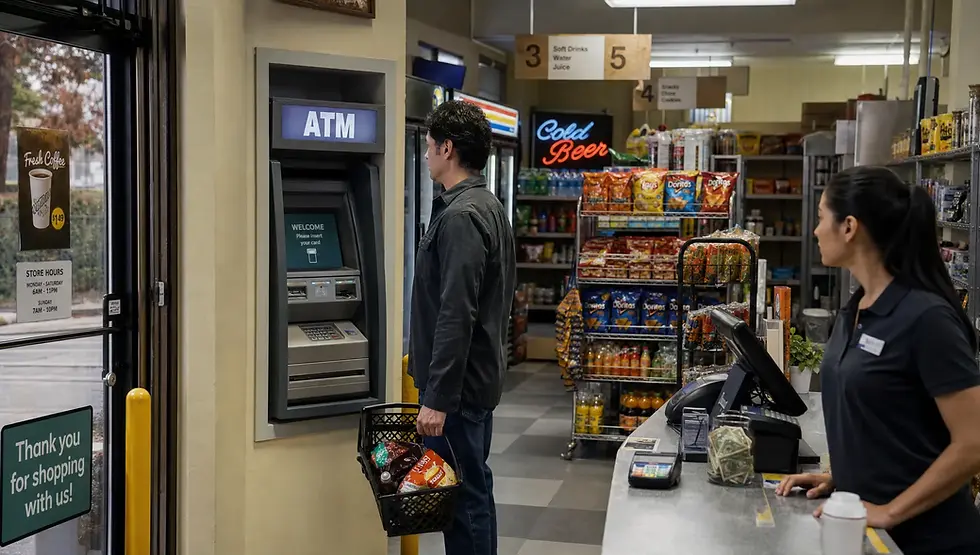
ATMs tend to perform best where customers already need cash, prefer cash, pay cover charges, tip staff, use cash-only services, or want quick access to funds without leaving the premises. Convenience stores, smoke shops, bars, nightclubs, restaurants, laundromats, event venues, truck stops, hotels, casinos, and similar locations often have stronger ATM use cases than low-traffic offices.
Denali ATM has a dedicated overview of ATM options for high-cash businesses, which is a useful starting point if your location already sees frequent cash transactions.
Consider these questions before choosing a machine:
How many customers enter the location on an average weekday and weekend day?
Do customers often ask where the nearest ATM is?
Is your business in an area with limited nearby bank ATMs?
Do you have enough secure space for a freestanding, wall, or countertop ATM?
Will you load cash yourself or use an armored service?
Do you want a basic cash-dispensing unit or a machine with upgraded features such as contactless card reading?
The right card reader ATM machine is not always the most expensive one. It is the one that fits customer behavior, expected transaction volume, and your ability to maintain cash availability.
Business setting | ATM priority | Why it matters |
Convenience store or smoke shop | Fast transactions and high uptime | Customers expect quick access and may use cash for nearby purchases. |
Bar, club, or venue | Durable cabinet, visible placement, receipt reliability | Peak usage often happens during busy evening hours. |
Restaurant or salon | Compact footprint and easy customer access | The ATM must fit naturally without disrupting operations. |
Hotel or truck stop | Reliable processing and larger cash capacity | Customers may need cash outside normal banking hours. |
Outdoor-adjacent or lobby location | Security, lighting, and placement | Visibility and deterrence become more important. |
Card reader features to prioritize
When comparing ATM models, focus on the card reader and payment experience first. The customer does not care how good the cabinet looks if the machine struggles to read cards.
EMV chip support
EMV chip support should be considered essential for a modern ATM purchase. Chip cards reduce certain types of counterfeit-card risk and are now standard for U.S. consumers. If a used or older machine does not support EMV, be cautious, even if the upfront price looks attractive.
Contactless card reading
Contactless capability is increasingly important because customers are used to tapping cards and mobile wallets at checkout. For some locations, tap transactions may also help move lines faster because customers do not need to insert and remove a card.
If you want a new ATM or an upgrade path for an existing unit, Denali ATM’s Tap 2 Pay contactless add-on is worth reviewing as part of your card reader comparison.
Reader durability
A high-traffic ATM needs a reader built for repeated use. Look for a machine from a reputable manufacturer, with parts availability and service support. The cheapest machine can become expensive if the reader fails, replacement parts are hard to source, or the vendor does not provide timely help.
Anti-skimming awareness
Skimming remains a security concern for ATM operators. Ask about security features, inspection procedures, and staff training. Even the best hardware should be paired with routine visual checks, good lighting, camera coverage, and employee awareness.
Simple customer flow
A good ATM makes the transaction obvious: insert, dip, swipe, or tap, then follow the prompts. Confusing prompts can lead to abandoned transactions, support calls, or customer frustration. The screen, receipt printer, PIN pad, and card reader should work together as a smooth user experience.
Choose the right ATM format for your space
The best card reader is only useful if the ATM fits your physical location. Most small and midsize businesses choose one of three common formats: freestanding, wall-mounted or countertop, or through-the-wall.
Freestanding ATMs are common in stores, bars, restaurants, and smoke shops because they are visible and relatively easy to position. They usually offer a strong balance of footprint, capacity, and customer familiarity. For many owners comparing their first machine, a dependable freestanding model such as the Genmega G2500 ATM can be a practical place to begin evaluating features and costs.
Wall-mounted or countertop units can work well where floor space is limited. They may be suitable for smaller locations, office-style environments, or businesses that want a compact unit in a controlled area.
Through-the-wall ATMs are built into a wall so customers access the front while the service side remains secured behind the wall. These can be excellent for certain layouts, but they usually require more planning, installation work, and physical space preparation.
ATM format | Best fit | Main advantage | Planning consideration |
Freestanding ATM | Retail stores, bars, smoke shops, restaurants | Flexible placement and familiar customer experience | Needs secure floor space and power/connectivity access. |
Wall or countertop ATM | Smaller locations with limited floor area | Compact footprint | Must still be visible and comfortable for customers to use. |
Through-the-wall ATM | High-traffic sites, exterior access, secured back rooms | Strong separation between customer and service access | Requires wall modification and installation planning. |
Processing, connectivity, and reporting matter as much as hardware
An ATM is not just a machine you plug in. It needs processing, network connectivity, settlement, reporting, and support. When you compare vendors, ask how the ATM will be boarded, how transactions are routed, how surcharge revenue is reported, and what happens if a transaction fails.
A strong ATM processing setup should help you track performance and resolve issues quickly. Business owners should be able to see transaction activity, monitor cash usage, and understand when the machine needs attention. Denali ATM highlights ATM processing service, 24/7 support and reports, and staff training as part of its offering, which are exactly the types of support layers to look for when buying equipment.
Connectivity is another practical issue. Many ATMs use wired internet, wireless, or other communication options depending on the location and model. A stable connection helps reduce failed transactions and customer complaints. If your internet is unreliable, discuss alternatives before installation rather than after the machine is already on-site.
Also ask about compliance responsibilities. The ATM industry involves security standards, encryption, card-network rules, and processor requirements. You do not need to become a payments engineer, but you do need a vendor that understands the rules and can explain what is required in plain English.
Security features every business owner should review
ATM security is both physical and digital. A good machine should discourage tampering, protect customer transactions, and make routine monitoring easier for staff.
Start with placement. The ATM should be visible enough that customers feel comfortable using it and staff can notice suspicious behavior. Avoid hidden corners, blocked sightlines, and poorly lit areas. If the machine is in a business that operates late at night, lighting and camera coverage become even more important.
Next, review the cabinet and access points. Ask how the vault is secured, how cash cassettes are accessed, and whether the ATM can be bolted down. A machine in a high-traffic or late-night environment may need stronger physical planning than a machine in a daytime retail lobby.
Finally, think about daily procedures. Staff should know how to inspect the card reader area for anything unusual, how to respond to customer issues, and who to contact for support. If the vendor provides training, use it. Even a short training session can reduce mistakes and help employees spot problems earlier.
Understand total cost, not just the sticker price
When buying an ATM, the purchase price matters, but it is not the full financial picture. A lower-cost machine may be a great choice if it is reliable, supported, and properly configured. A cheaper unsupported machine can become a liability.
Common cost factors include the machine itself, shipping, installation, optional upgrades, signage, cash loading, receipt paper, connectivity, repairs, replacement parts, and processing terms. Financing may also be relevant if you want to preserve cash while adding equipment.
Cost factor | What to ask before buying |
Machine price | What is included in the listed price, and what upgrades are optional? |
Shipping | Is nationwide shipping available, and how is delivery handled? |
Installation | Will you install it yourself, use a local technician, or need vendor guidance? |
Processing | What reporting, settlement, and support are included? |
Supplies | Are receipt paper and starter supplies included? |
Upgrades | Is a camera, contactless reader, or signage included or added separately? |
Support | Who do you call after hours if the ATM is down? |
Financing | Are financing options available for qualified buyers? |
This is where transparent pricing and bundled upgrades can make your decision easier. For example, if one ATM package includes a built-in camera, receipt paper, support, and training while another only includes the bare machine, the cheaper quote may not be the better value.
Evaluate the vendor as carefully as the machine
A card reader ATM machine is a long-term business asset. You are not only buying hardware, you are choosing a company that can help you keep it earning.
Look for experience, parts access, processing knowledge, clear communication, and support after the sale. Ask how long the company has worked with ATMs, what brands it supports, and whether it can help with configuration, reporting, and troubleshooting. Denali ATM emphasizes decades of ATM experience, wholesale ATM sales, nationwide shipping, processing, support, and financing, which are all relevant points to compare against any competing quote.
This same due diligence applies to any revenue-generating equipment investment. Whether you are evaluating ATMs, vending equipment, kiosks, or specialized hardware sectors such as ASIC miner sales and hosting in Dubai, uptime, support, vendor credibility, and lifecycle costs all influence the real return on investment.
Before you buy, ask the vendor direct questions:
Which card reader technologies does this ATM support?
Is EMV included and is contactless available?
What happens if the reader fails after installation?
How are software updates or configuration changes handled?
What reporting tools are available?
What support is available after business hours?
Are staff training and setup guidance included?
A vendor that answers clearly is usually a safer partner than one that only pushes the lowest price.
Common mistakes to avoid
Many first-time ATM buyers focus on the machine price and overlook the operational details. That can lead to avoidable problems.
One common mistake is buying an outdated ATM because it appears inexpensive. If the card reader, software, or parts availability is behind current expectations, you may spend more upgrading or replacing it later.
Another mistake is placing the ATM where customers do not notice it. Visibility matters. Add clear signage, keep the area clean, and make sure the customer path feels natural.
A third mistake is ignoring cash management. If the ATM runs out of cash during peak hours, customers lose trust and you lose transactions. Estimate usage carefully and review reports so you can adjust loading schedules.
Finally, do not assume all “ATM” offers are equal. True ATM processing, cash dispensing, EMV support, and network compliance are different from retail card acceptance or questionable cashless setups. If something sounds like a shortcut around card-network rules, get clarification before proceeding.
Final checklist before choosing your ATM
Use this quick checklist when comparing your options:
Choose a true ATM designed for cash dispensing and ATM processing.
Require EMV chip support as a baseline.
Consider contactless card reading if your customers value speed and convenience.
Match the cabinet style to your available space and traffic.
Confirm processing, reporting, support, and settlement details.
Review security features, placement, lighting, and staff inspection procedures.
Compare total cost, including shipping, supplies, upgrades, and support.
Work with a vendor that can explain setup and service clearly.
The best ATM decision is not about buying the flashiest machine. It is about matching the right reader, cabinet, processor, and support program to your business.
Frequently Asked Questions
What is a card reader ATM machine? A card reader ATM machine is an ATM that reads customer cards through a magnetic stripe, EMV chip, contactless tap, or a combination of these methods so the customer can authenticate and withdraw cash.
Should I buy an ATM with contactless card reading? Contactless card reading is worth considering if you want a faster, more modern customer experience. It can be especially useful in busy retail, bar, venue, and convenience environments where quick transactions matter.
Is EMV required for a business ATM? EMV chip support is strongly recommended for modern ATM ownership in the United States. It is an industry standard and helps reduce risks tied to older magnetic-stripe-only transactions.
How much space do I need for an ATM? It depends on the format. Freestanding ATMs need secure floor space and customer clearance, wall or countertop units need a stable mounting area, and through-the-wall machines require more installation planning.
Can an ATM help my business make money? An ATM can create surcharge income and may help keep customers on-site when they need cash. Results depend on location traffic, customer cash demand, surcharge settings, uptime, and cash availability.
What should I ask an ATM vendor before buying? Ask about EMV, contactless options, processing, reporting, support hours, warranty or service expectations, shipping, installation guidance, cash loading, and what is included in the quoted price.
Ready to choose the right ATM for your business?
If you are comparing ATM machines, start with the card reader, but do not stop there. The right choice combines secure card acceptance, reliable processing, practical placement, visible signage, cash management, and ongoing support.
Denali ATM helps U.S. business owners buy wholesale ATM machines with nationwide shipping, processing options, support, training, financing availability, and industry-specific guidance. If you want a machine that fits your location and your customers, use the checklist above and speak with an ATM specialist before you buy.


Comments