ATMs Cash Machine Guide for Retail and Hospitality
- Jul 10
- 9 min read
Updated: Jul 11

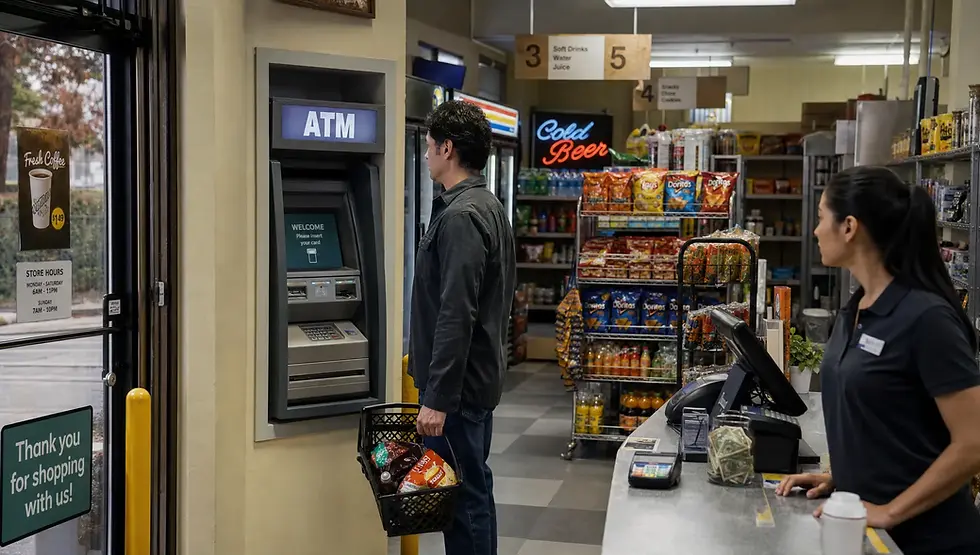
An ATM cash machine can do more for a retail store, restaurant, bar, hotel, or entertainment venue than simply dispense cash. When it is placed well and supported by the right processing setup, it can improve customer convenience, reduce friction for cash-preferred guests, and create an additional revenue stream through surcharge income.
For business owners, the key is not just buying a machine. The real decision is choosing the right ATM for your space, customer traffic, operating hours, cash-handling process, and support needs. The number one selling hospitality ATM today (and for the last 7-years) is the Genmega G2500 ATM. To see why this is so popular, click this LINK. This link walks through the practical decisions retail and hospitality owners should make before adding an ATM to their location.
Why cash access still matters in retail and hospitality
Card, mobile wallet, and tap-to-pay adoption continue to grow, but cash has not disappeared from in-person commerce. The Federal Reserve’s Diary of Consumer Payment Choice continues to show that cash remains relevant, especially for smaller purchases and certain consumer groups.
That matters for retail and hospitality because these businesses often serve a broad mix of customers. A convenience store may see workers stopping in between shifts. A bar may attract customers who want quick cash for tips, cover charges, pool tables, games, or nearby events. A hotel may host travelers who need cash for valet, local transport, or small purchases.
An ATM cash machine can also keep customers on-site. If a customer has to leave your store or venue to find cash, there is a chance they do not come back. A convenient ATM helps capture that demand inside your business instead of sending it to a bank, gas station, or competitor.
Which retail and hospitality businesses benefit most?
ATMs tend to perform best where foot traffic, cash preference, and convenience overlap. That does not mean every business needs the same machine or the same placement strategy. A compact boutique has different needs than a high-volume nightclub or truck stop.
Business type | Why an ATM may help | Placement priority |
Convenience stores and gas stations | Frequent small purchases, high foot traffic, cash-preferred customers | Near checkout but visible from the entrance |
Smoke shops and liquor stores | Strong cash usage, repeat customers, quick transactions | Close to the counter with clear signage |
Restaurants and bars | Tips, cover charges, split bills, late-night cash demand | Visible but away from congested dining paths |
Hotels and motels | Traveler convenience, valet tips, local spending needs | Lobby or market area with 24-hour visibility |
Salons, tattoo shops, and barbershops | Tips and appointment-based payments | Waiting area or reception zone |
Event venues and entertainment centers | Games, concessions, tips, parking, vendor payments | High-traffic corridor with strong lighting |
If your business already sees meaningful cash transactions, you may want to compare your situation with Denali ATM’s overview of high-cash businesses to understand where ATM demand is often strongest.
Buy, lease, or use an ATM placement program?
The ownership model affects your upfront cost, control, and long-term revenue. There is no universal best choice, but there is usually a best fit for your business stage and traffic.
Buying an ATM gives you the most control. You own the equipment, you can usually keep more of the surcharge revenue depending on your processing agreement, and you can choose a model that fits your location. This is often attractive for established retail and hospitality businesses that expect consistent transactions.
Leasing or financing can make sense if you want ownership benefits without paying the full amount upfront. In this case, compare the total cost over the full term, not just the monthly payment. Also ask who handles service, processing, receipt paper, software updates, and reporting.
A placement program may reduce or eliminate your upfront equipment cost, but you typically give up some control and revenue. It may be suitable for locations that want convenience for customers but do not want to manage equipment ownership.
Before you choose, estimate likely transaction volume, compare your options, and read the full processing agreement. The lowest initial cost is not always the lowest total cost.
Choosing the right ATM cash machine for your space
A machine that works well in a liquor store may not be ideal for a hotel lobby or restaurant hallway. Start with physical space, transaction expectations, and the user experience.
Freestanding ATMs are common in retail because they are easy to place, easy to see, and suitable for a range of locations. They are often a good fit for convenience stores, smoke shops, bars, and restaurants with enough floor space.
Wall-mounted or countertop ATMs can work well where space is limited. These are useful for small retail shops, salons, quick-service counters, and locations where every square foot matters.
Through-the-wall ATMs are more specialized. They can support access from outside a building or secured vestibule, but they require more planning, construction, and compliance review. These are typically considered for higher-traffic or purpose-built locations.
Video or coupon-capable ATMs may be worth evaluating if you want to use the ATM as a promotional tool, not just a cash dispenser. For example, a machine that can support coupons or marketing messages may help hospitality businesses promote specials, events, or nearby offers.
For many business owners comparing full-size models, Denali’s Genmega G2500 ATM machine review is a helpful starting point because it explains buyer considerations beyond the basic spec sheet.
Where to place an ATM for visibility, safety, and transactions
Placement can make or break ATM performance. A machine hidden in a hallway may be secure, but customers may not notice it. A machine placed too close to a crowded entrance may be visible, but uncomfortable or inconvenient to use.
The best ATM locations usually share a few qualities: strong visibility, good lighting, enough privacy for PIN entry, access to power and connectivity, and a natural fit with customer flow. In retail, that often means near the checkout area, but not directly in the checkout line. In hospitality, it may mean near the host stand, lobby, bar entrance, or high-traffic corridor.
Accessibility also matters. ATMs should be evaluated with the 2010 ADA Standards for Accessible Design and applicable local requirements in mind. Clear floor space, reach range, route accessibility, and obstruction-free placement should be considered before installation.
Security should be part of the placement plan from the beginning. A good ATM location is visible to staff or cameras but not so exposed that customers feel watched while entering a PIN. If the ATM is accessible after hours, think carefully about lighting, building access, alarms, and cash replenishment procedures.
If you are opening, remodeling, or relocating a retail or hospitality space, coordinate ATM placement early with your contractor, equipment supplier, and moving team. For example, Bay Area operators planning a store or restaurant move may work with a licensed commercial mover such as Zapt Movers so fixtures, safes, counters, and ATM equipment are moved in the right sequence.
Processing, fees, and revenue: what owners should understand
ATM processing is the system that connects the machine to the networks that authorize withdrawals, route transactions, settle funds, and generate reporting. For a business owner, the processor relationship is just as important as the machine itself.
The main revenue driver is the surcharge fee paid by the ATM user. Your actual income depends on the surcharge amount, transaction volume, any interchange or network compensation, cash-loading costs, service costs, and the terms of your processing agreement. Do not rely on generic earnings claims without comparing them to your location’s real traffic.
Factor | Why it matters | What to ask |
Surcharge amount | Drives gross revenue per withdrawal | Who controls the surcharge and how is it changed? |
Settlement timing | Affects cash flow and reconciliation | When are funds deposited and reports available? |
Reporting access | Helps track performance and issues | Are online or 24/7 reports included? |
Support coverage | Reduces downtime | Who answers service calls and when? |
Connectivity | Keeps transactions running | Does the machine use phone line, Ethernet, wireless, or another option? |
Compliance support | Reduces risk | Who helps with network, software, and operational requirements? |
A strong processor should be transparent about fees, settlement, reporting, uptime expectations, and support. Before signing, use Denali’s ATM processor checklist for small business owners to compare providers in a structured way.
Security and cash management basics
An ATM holds cash, so security and replenishment should never be improvised. Your plan should answer three questions: who loads the ATM, how often it is loaded, and how the cash is protected before, during, and after loading.
Some owner-operators load their own cash. Others use an armored service or third-party cash vaulting arrangement. The right choice depends on volume, staffing, insurance, local risk, and how much time you want to spend managing cash.
Good cash management starts with forecasting. If the machine runs out of cash during peak hours, you lose transactions and customers lose confidence. If you overload the machine, you may tie up too much working capital. Track withdrawals by day and time so you can adjust replenishment schedules around weekends, holidays, events, and seasonal traffic.
Security features also matter. Look for a strong vault, reliable locking mechanisms, camera options, tamper-resistant design, and proper anchoring. A built-in camera can add an extra layer of accountability, but it should be combined with thoughtful placement, lighting, and staff awareness.
PCI standards may also apply to parts of your payment environment. The PCI Security Standards Council is a useful reference point for understanding broader payment security expectations, although your ATM provider and processor should guide you on the specific requirements that apply to your machine and network setup.
Staff training and daily operating procedures
The best ATM setup is one your staff knows how to support. Employees do not need to become technicians, but they should know what to do when a customer has a question, the receipt paper runs low, or the screen displays an error.
Create a simple procedure for common situations. Staff should know who to call for service, how to identify the machine, where receipt paper is stored, and what information to collect from a customer if a transaction concern comes up. They should also understand that they should never ask for a customer’s PIN or handle a customer’s card.
For hospitality businesses, training is especially important because peak ATM usage may happen at night, during events, or when managers are busy. A bartender, front desk employee, or shift lead should know how to escalate an issue quickly so the machine does not sit offline during your busiest hours.
When comparing ATM suppliers, ask whether receipt paper, reporting access, support, and staff training are included. Bundled support can reduce surprises after installation and make the ATM easier to manage long term.
A practical rollout plan for your first ATM
A successful ATM launch does not have to be complicated, but it should be planned. Treat it like any other revenue-producing asset in your business.
Estimate customer demand: Look at foot traffic, cash requests, nearby bank access, tip culture, and event schedules.
Choose the ownership model: Compare purchase, financing, lease, or placement based on control, cost, and expected revenue.
Select the machine format: Match the ATM to your floor space, hours, transaction volume, and customer flow.
Confirm processing terms: Review surcharge control, settlement timing, reporting, support, connectivity, and contract terms.
Plan installation and security: Decide placement, anchoring, lighting, accessibility, cash loading, and camera coverage.
Train staff and track results: Teach basic procedures, monitor reports, review cash-outs, and adjust placement or signage if needed.
After launch, measure performance for at least 60 to 90 days before making major conclusions. ATM usage can vary by day of week, season, weather, and local events. If transactions are lower than expected, small changes like improved signage, better lighting, or moving the machine closer to the customer path can help.
Common mistakes to avoid
Many ATM problems are preventable. One common mistake is choosing a machine only by purchase price. A lower-cost machine may still be the wrong choice if it lacks the format, support, or reliability your business needs.
Another mistake is underestimating downtime. Every hour your ATM is out of service is an hour it cannot serve customers or generate surcharge revenue. Processing support, parts availability, remote monitoring, and clear service procedures all matter.
A third mistake is treating cash loading casually. If you do not know your expected withdrawal pattern, the ATM may run out during busy periods or carry too much idle cash during slow periods.
Finally, avoid confusing a real ATM cash machine with noncompliant cashless workarounds. A legitimate ATM should dispense cash, disclose fees clearly, and operate through proper ATM processing channels.
Frequently Asked Questions
How much can an ATM cash machine earn in a retail or hospitality business? Earnings depend on surcharge amount, transaction volume, processor terms, cash-loading costs, and service costs. A simple estimate is monthly withdrawals multiplied by your net revenue per transaction, but you should use conservative assumptions until you have real transaction data.
Who fills the ATM with cash? Some business owners load the ATM themselves, while others use armored service or a third-party cash provider. The right choice depends on volume, staffing, insurance, and risk tolerance.
Where should a restaurant or bar place an ATM? Place it where customers naturally pass by, such as near the host area, bar entrance, lobby, or event corridor. Avoid blocking traffic, creating PIN privacy concerns, or placing the machine where staff cannot monitor the area.
Does an ATM need internet service? Many modern ATMs use Ethernet, wireless, or other connectivity options, depending on the model and processor. Ask your provider which options are supported and what backup plan is available if connectivity fails.
Is buying an ATM better than using a placement program? Buying usually offers more control and potential revenue, while placement can reduce upfront cost and management responsibility. The better option depends on your transaction volume, available capital, and how hands-on you want to be.
Ready to add an ATM to your business?
If you run a retail store, restaurant, bar, hotel, or other hospitality business, the right ATM can improve customer convenience and create a practical new income stream. Denali ATM helps business owners nationwide with wholesale ATM sales, shipping, processing, support, staff training, financing options, and multiple Genmega ATM models.
To compare options for your location, start with Denali ATM and get guidance on the machine, processing setup, and support plan that fits your business. Why pay more someone else for the same ATM machine.


Comments